

REQUEST FOR PROPOSALS
High Plains Conservation District is accepting proposals for contracting services for the Hound Creek Realignment and Floodplain Reconnection Project. Proposals are due by August 25th, 2026. Interested parties may view the linked RFP and project designs for more information, or reach out to Jake Atkinson at (406)-403-2644 or hpcdtech@cascadecd.com.
RFP Schedule
RFP Released July 24th, 2026
Optional Site Tour August 3rd, 2026
Deadline for Receipt of Written Questions August 7th, 2026
Deadline for CCD Answers to Questions August 14, 2026
Deadline for Receipt of Responses to RFP August 25, 2026
RFP Q & A
The Hound Creek RFP Q&A period is now closed. All questions and answers are posted below.
Lower Hound Creek Restoration Project – Phase 1 Questions and Responses
August 14, 2026
1. Have any permits been filed? Are any permits the responsibility of the contractor?
Yes, all permits have been filed. The project requires a SPA 124 from Montana Fish, Wildlife and Parks; a section 404 permit from the Army Corps of Engineers; and a 401/318 authorization from the Montana Department of Environmental Quality. The SPA 124 and 401 waiver have been received and the 404 permit is anticipated by early to mid-September.
2. Will willow cuttings be available on demand?
No. Willow cuttings for the project will be provided by High Plains Conservation District and will be collected by volunteers. Cuttings are expected to be collected over several days and days will be scheduled after a Contractor is selected and their anticipated schedule determined.
3. Can we get access to CAD files?
Yes. CAD files will be made available to the contractor awarded the work.
4. Will engineers stake the work?
Yes. Geum Environmental Consulting will stake work extents, treatment locations, and cut and fill elevations as needed. Geum will also be available to check elevations for the contractor during construction. Up to two benchmarks will be established that can also be used by the Contractor to check their own elevations.
5. Is there any historical data available for Hound Creek flows?
There is no stream gauge on Hound Creek. Geum used existing channel dimensions and regional regression equations to determine streamflow return intervals for the project. One discharge measurement was taken at the upstream extent of the work area on March 11, 2026 and was 13.4 cubic feet per second (cfs).
6. Can we rebuild the access ramp into the south side if needed?
Yes.
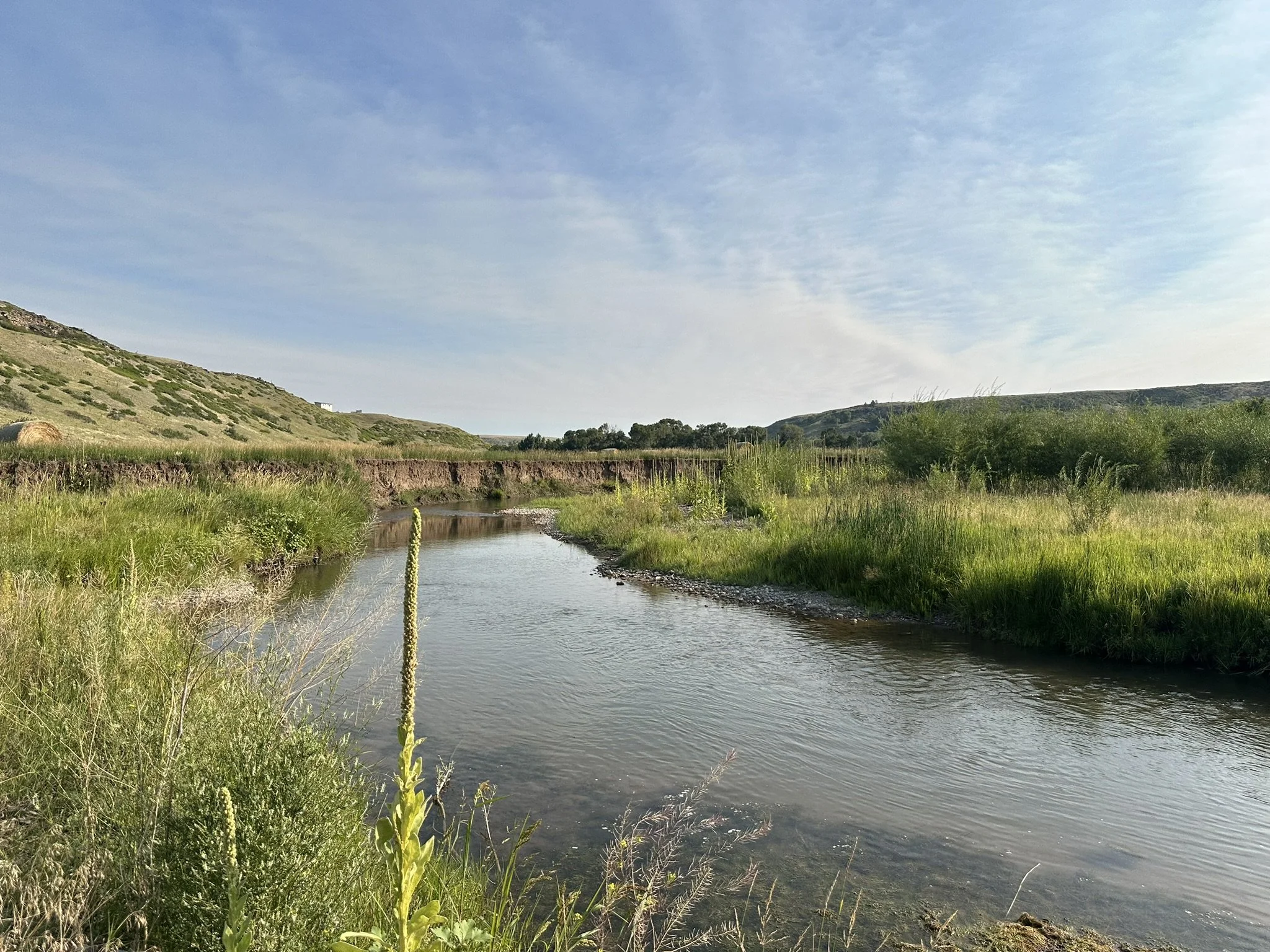
7. How will the vertical eroding bank be treated?
The design calls for creating a 3:1 slope along the current vertical bank. This slope will be constructed using a combination of excavation and fill.
8. Are the water gap gates and rail fences part of the work (Bid Item 12 INSTALL WATER GAP)?
No. The landowner will install gates, rail fences, and panels for each water gap. The contractor is responsible for earthwork and rock import and placement only.
9. Are the side channels included in the design for high water?
Yes. They are also intended to create trout spawning/rearing habitat and increase activation of the floodplain.
10. Do we have the option of getting all the cottonwoods from one site vs multiple sites?
Yes. If all of the cottonwoods are available at one site that is acceptable. Cottonwood stands are in various conditions ranging from young to decadent. It is expected that selective collection from multiple stands will be needed to acquire trees that meet the size specifications in the construction drawings. Harvest from wet areas or within 50 feet of active channels is not allowed. Removing all trees from an area is also not acceptable.
11. Are there gates to access all wood sources?
Yes. However, it is also acceptable to cut the fence for access and repair it once access is no longer needed. This must be coordinated with the landowner to ensure that livestock are not in areas where fence is cut.
12. Are contractors responsible for mitigation or restoration of areas impacted by machinery or equipment?
Yes. The Contractor is responsible for cleaning up tracks or ruts in areas accessed for the work.
13. Do contractors have responsibility for seeding?
No. The Contractor is not responsible for seeding.
14. Are the three large willow stumps near the landowner home required to be removed and used for the project?
Yes as long as the landowner still requests this at the time of work. Removal of these willows will require careful excavation around the roots to minimize disturbance. The Contractor is not responsible for filling holes left after tree excavation but should smooth and blend edges to the extents possible.
15. How many junipers are needed and available?
The exact number of junipers needed to complete the work is uncertain because the actual size of junipers to be collected can vary and the tops of cottonwood trees collected for large wood structures can also be used in WOOD AND WILLOW BANK TREATMENTS. Collection and transport of cottonwoods and junipers are incidental to Bid Items 6 (WOOD AND WILLOW BANK TREATMENT – MAIN CHANNEL), 7 (WOOD AND WILLOW BANK TREATMENT – SIDE CHANNEL), 8 (LARGE WOOD HABITAT STRUCTURE), and 11 (FLOODPLAIN ROUGHNESS TREATMENT).
16. Is there a limit or restriction on how many juniper contractors may take?
No. Junipers may be harvested completely from designated areas on Sheet 2.1; however, junipers should not be removed from any location where removal may cause soil erosion or instability.
17. Is the bridge into the site accessible for equipment?
Uncertain. The bridge located approximately 0.25 miles after the access road turn into the site may not be wide enough for excavators or dump trucks to cross and may be weight-limited for loaded trucks. Equipment can access the site from the northwest side of Hound Creek to avoid use of this bridge. Imported rock can also be delivered and unloaded on the northwest side of Hound Creek. Trucks loaded with cottonwoods and junipers do not need to cross this bridge to access the work area.
The bridge over the Smith River (approximately 2 miles from access road turn) that provides access to some of the potential cottonwood harvest sites can accommodate equipment and loaded trucks.